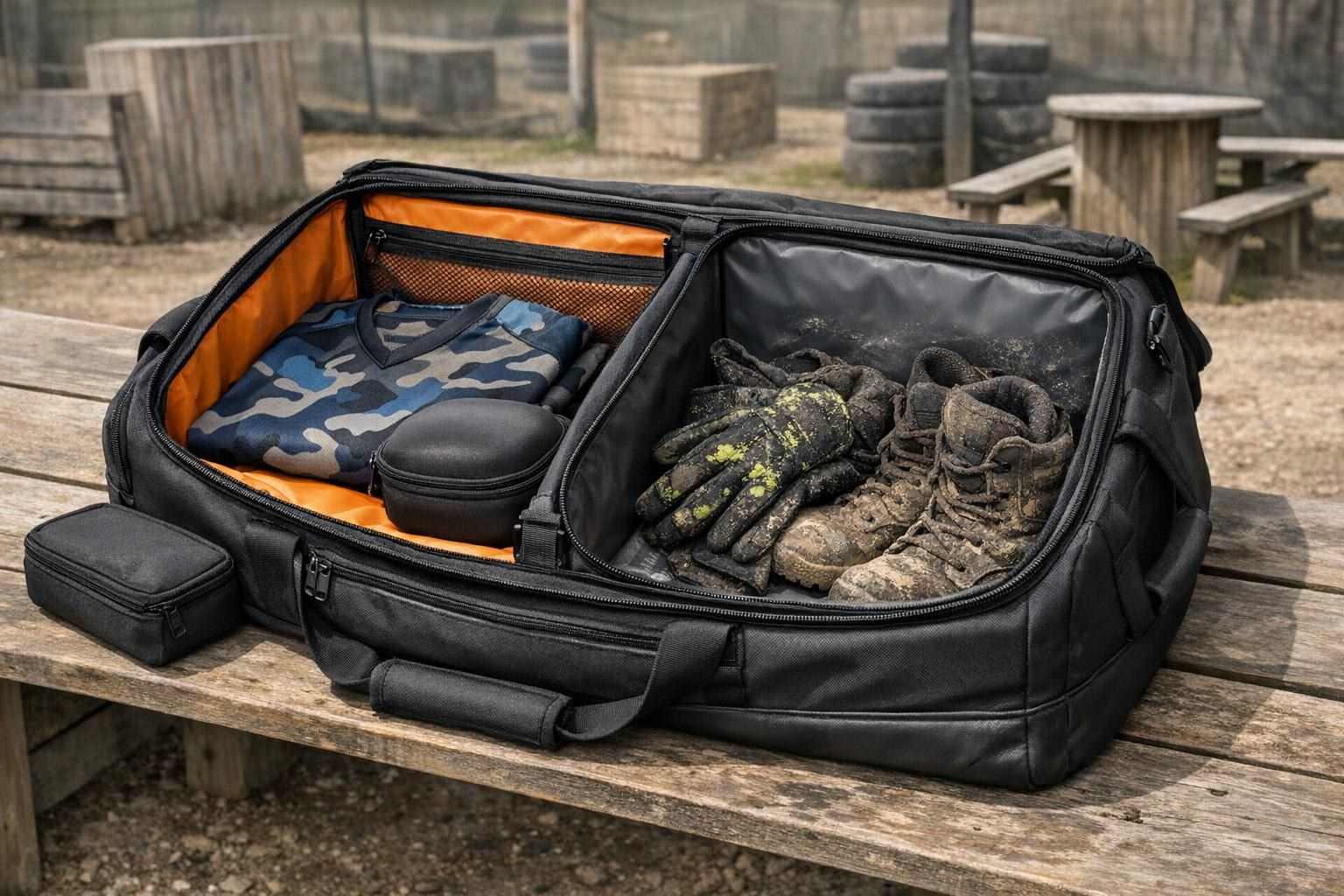

This is a job that no one wants to do but someone has to. To keep your gear clean and your clothes and other gear clean of paint and grass, you need a good paintball gear bag. In this article we will outline the key points to consider when looking for a new paintball gear bag or when re-organizing your current paintball gear bag. Don't just look at the capacity of the bag, look at the separation of items, the cleanliness of the materials used and the access to the different sections of the bag.
Start with the separation problem
Don't start by looking for how many liters your new paintball bag can hold. Think about what needs to be kept clean, what might get wet, and what needs to be checked before you put it away for storage.
Set up the main areas for the clean clothes and playing gear first, and then add a section for footwear and for tools and accessories. The used jerseys, gloves and padded clothing can contain a lot of paint, grass and even moisture. So it's best to keep these items away from your clean clothes. A mask lens cloth, spare batteries, snacks or a dry base layer would also be best to keep in a separate area from the other dusty items.
You want to look for a separate compartment or area in the bag for dirty items. This could be a closed pocket or even a separate, closed area within the main compartment of the bag. A good divider will stay in place when the bag is laid on its side, but zip-up pockets, flapped pockets and removable, washable liners can also be used to good effect to keep different types of items separate.
A clear and recognizable boundary is important. As much as possible the boundary should be clearly recognizable. In many cases, contrasting colors or compartments with clear labels are sufficient to recognize the different sections within the paintball gear organizer. The use of a divider with labels can also be a good solution.
Match the layout to your field routine
Think about your routine and how you use your kit before you go to play paintball. This will help you to work out the best layout for your bag. Initially you will need to be able to get to your mask, playing clothes, loader accessories and personal protective equipment quickly. After the game you will need to be able to put your dirty equipment somewhere, without getting it into contact with your clean clothes or other clean equipment such as your electronics.
Bulky items, such as outer clothing and equipment for protection, can be stored in the wide-opening main section of the bag. In addition to this, there are often a number of smaller external pockets. These are perfect for items that you require access to before you head out to play and which would otherwise be buried at the bottom of the main section of the bag. They are ideal for storing items such as cases for the eye, keys, field cards, etc. Also, remember to store fragile items in soft, padded pouches or in specialized cases to prevent damage. Likewise, hard tools and metal accessories should be stored away from items of fragile nature to prevent breakage.
On long car journeys down to fields (or indeed hiking across rough terrain) consider bags with sturdy bases so they won't topple over whilst loading/unloading kit. Additionally padded shoulder straps and quality durable handles are important for 'carrying' your paintballing gear around on long adventures.
There is a big difference between a large capacity bag that will store loads of kit and a well organized bag of the right size for a regular player. A smaller bag with separate areas for different types of kit is often the better choice.
Choose materials for paint, moisture and cleaning
While a water-resistant exterior can help protect against light and some stains, no fabric is completely immune to wet equipment. In addition to protecting against stains, the exterior, as well as the seams, zippers, and bottom of the bag, must be able to withstand dirt and moisture.
Ventilation: A section for used clothes to dry off of while in transit. Ideally this section would be isolated from clean clothes to prevent moisture transfer. Be wary of openings for ventilation, as these can let in dust and water as well.
A removable liner for the dirty side of the bag is also very useful. This can be washed and cleaned and then put back in the bag. Check with the manufacturer to see if the lining of the bag can be washed and what care method the bag can be cleaned with. Just because a bag is machine washable does not mean that it can be put in a washing machine. Many bags with stiff panels, coatings and foam may get damaged in a washing machine.
Do not pack a soaked item with other items, especially paintball field equipment such as electronics, paintball markers, paintball ball pens, paintball FIELD PLANS, batteries, etc. Use a separate, washable sack for wet items as needed, and make sure to open up the sack to dry out as soon as possible.
Build a practical packing system
A great paintball gear organization system is based on fixed places for all items instead of additional pockets. That means one compartment for clean clothing and eye protection and a second one for used clothes and shoes. The tools, lubricants, cleaning agents and other maintenance items for paintball gear should be stored in a small pouch which can be removed from the main part of the bag before soiled items are handled.
Empty out your gear after play and dry the items as quickly as possible to prevent them getting dirty or damaged. It's then easy to see if anything is missing or if there has been any damage, e.g. paint on the strap of your gloves, a cracked lens case, lost squeegees, loose parts, etc. This makes for a quick and easy check over.
Do not store tools with fabric items. Let paint, moisture and cleaning agents have their own area. Regulated items such as air, paintball markers, etc. must be stored according to the manufacturer's instructions and for the items that have field, transport and storage requirements for that field these must be checked prior to traveling for current requirements.
A small inventory card, such as that found here, or even a simple phone list with all your gear listed out as to what are the items you normally take with you, then listed out as to which of those need to be clean, dry, etc. protected from damage or even inspected prior to use will expose a bag overloaded with other items of little use to the paintball player.
Check the bag before committing
Give the compartments a test run by placing the respective equipment into the compartments labeled 'clean' and 'dirty'. Pack your maintenance equipment into the pouch that is allocated for this purpose. If an item is too big for a compartment or has to be placed in such a way that clean equipment will get dirty, then the organization of that bag is not optimal for you.
Examine the stitching, handles, base, zipper, and where the dividers attach to the bag. Make sure they can withstand normal use. The dividers should be able to be pulled gently and release, but not be so rigid that they wouldn't move in a somewhat packed bag of equipment.
Check a bag that is only partially packed for stability to remain upright and to close easily. A bag only useful when fully packed will be a cause for concern on busy days at the field.
Also make sure that the Paintball gear storage area allows air flow and is easily accessible to check on equipment from time to time. Do not treat your bag as a closed drying cabinet and make sure to empty it from time to time, separate wet gear from the rest, clean any dirty gear and then store sensitive items in accordance with their care.
The most important factor is the equipment will be stored in the best bag for your habits. The feature of clean/dirty separation is not the storage feature, but rather the different areas in the bag for different types of equipment that you can easily access and use for packing.